Submit the form below and one of our estimators will get back to you shortly.
Road and Roadway Paving Built for the Full Length of the Rout
A road carries weight differently than a driveway or a parking lot. Traffic moves along it continuously instead of parking and sitting, which means the surface takes repeated flexing at every point along its length, not just at entrances and turning points. Road and roadway paving has to account for that continuous stress, along with proper crown and slope so water sheds off the surface instead of pooling along the centerline or edges.
Gentry’s Paving Group has been paving roads, access lanes, and private roadways across the Dallas-Fort Worth metroplex since 1988. Our crew handles everything from short laneways serving a handful of properties to longer access roads for commercial and industrial sites, always building the base and surface layers around the traffic that road will actually carry over its lifespan.
Have a road or laneway project in mind? Call (972) 792-0000 or fill out our contact form to talk it through.
What Road & Roadway Paving Involves
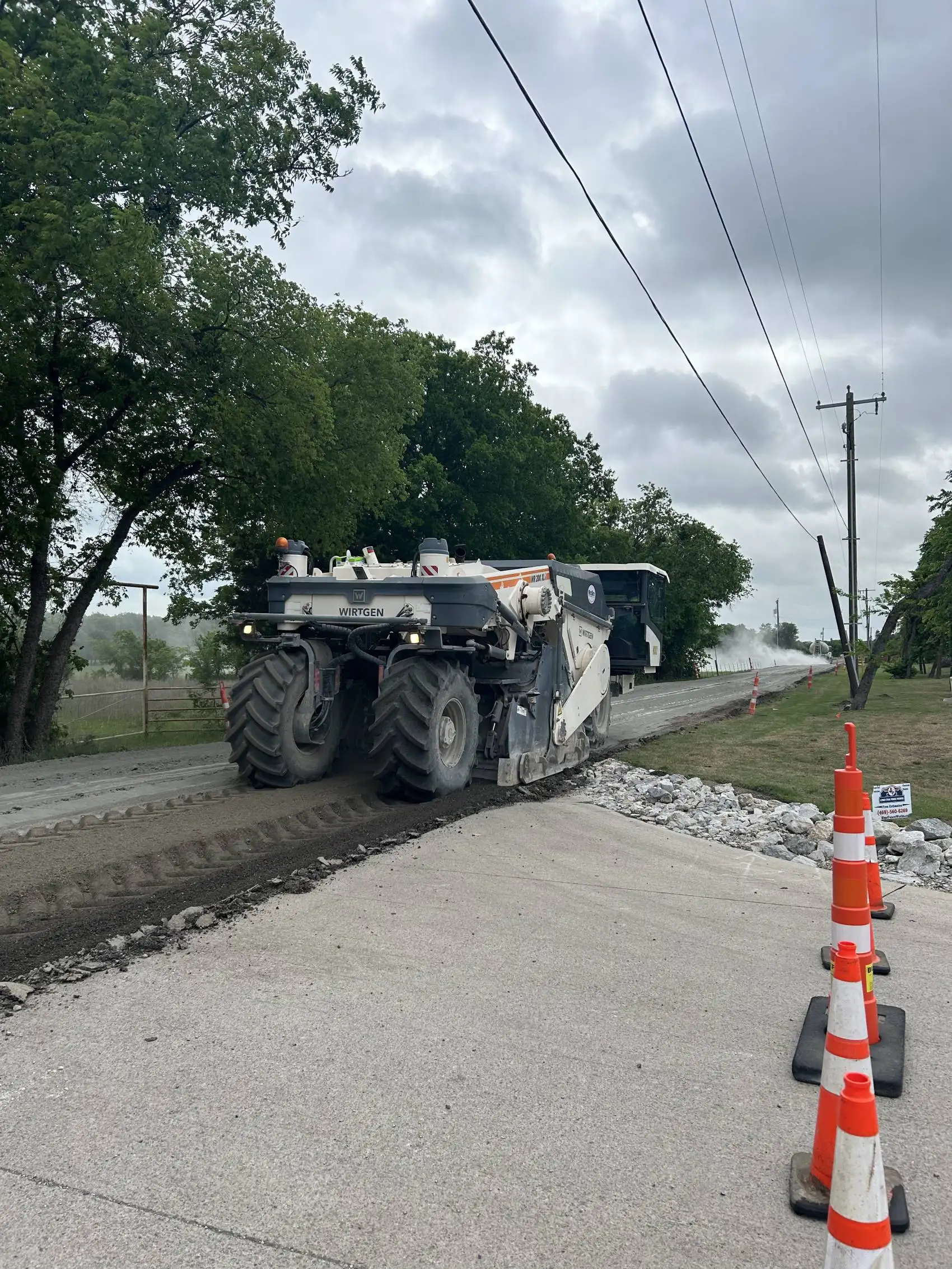
Road and roadway paving is the construction of a continuous driving surface, typically for private roads, access lanes, laneways, or roadways within a residential, commercial, or industrial property. Unlike a parking lot, where vehicles stop and start across an open surface, a road carries directional traffic along its full length, which puts sustained stress on every foot of pavement rather than concentrating it near entrances.
That continuous loading is why road construction leans heavily on crown and slope. A properly built road pitches slightly from the centerline toward both edges, so rainwater sheds off the driving surface instead of collecting in the middle of the lane. Skip that grading, and water finds the lowest point in the road and sits there, softening the base from underneath every time it rains.
Roadway paving also has to account for transitions, since roads connect to driveways, intersections, cul-de-sacs, and other roads. Those transition points see uneven traffic patterns and turning stress, and they’re a common place for early cracking if they aren’t tied into the main roadway correctly.
What’s Included in Road & Roadway Paving
- Access road construction. New paving for roads serving commercial, industrial, or multi-property residential sites.
- Laneway and pathway paving. Narrower paved routes connecting buildings, units, or parking areas within a property.
- Private subdivision and HOA road paving. Roads within residential developments that aren’t publicly maintained.
- Grading and drainage for roadways. Establishing proper crown and slope so water sheds off the road surface correctly.
- Intersection and transition tie-ins. Making sure new roadway paving connects cleanly to existing driveways, laneways, or roads.
If your road needs milling and resurfacing rather than new construction, that falls under our Asphalt Milling & Paving service.
Our Process
- Site walk and route assessment. We look at the full length of the roadway, existing grade, drainage low points, and how the road will connect to driveways or other roads before quoting the job.
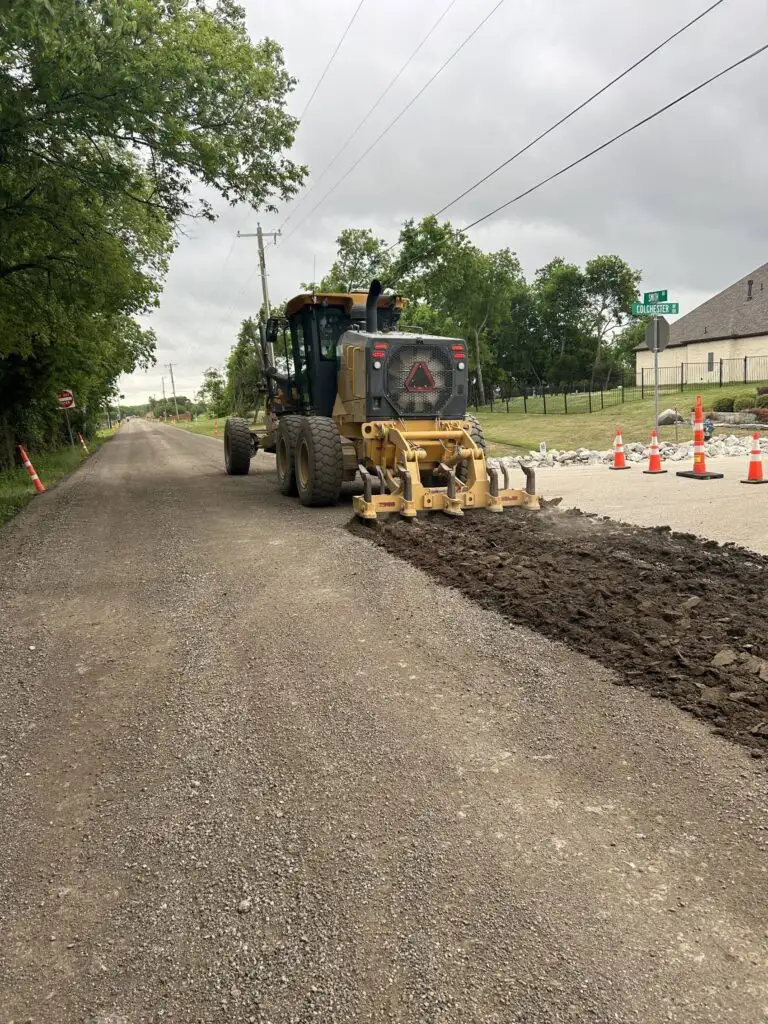
- Excavation and subgrade preparation. We clear the route down to a stable subgrade, removing organic material and old pavement, then check soil stability along the full length of the road, not just at one point. Roads have to hold up consistently across their entire distance, so weak spots anywhere along the route become weak spots in the finished pavement.
- Base placement and proof rolling. We place and compact an aggregate base, then run a loaded truck over it to check for soft or weak spots before paving begins. This catches problems while they’re still cheap to fix, rather than after asphalt is already down.
- Grading for crown and drainage. We establish the crown and slope along the roadway so water sheds toward the edges or drainage structures instead of collecting along the centerline. This is one of the details that separates a road that holds up for decades from one that starts failing within a few years.
- Binder course installation. The lower asphalt layer goes down first, giving the roadway its structural strength across its full length.
- Surface course installation. The finished driving surface goes down last, compacted for a smooth, uniform ride from one end of the road to the other.
- Transition and tie-in finishing. We finish the connections where the new road meets driveways, intersections, or other roadways, so there’s no abrupt edge or joint that becomes a weak point.
Warning Signs Your Road Needs Repaving
- Rutting in the wheel paths. Channeled depressions running along the direction of travel usually mean the base underneath is failing under repeated traffic.
- Cracking along the length of the road. Roads naturally develop some cracking over the years, but a heavy buildup of unsealed cracking is a sign the surface is due for attention before it turns into potholes.
- Water pooling along the centerline or edges. If water sits on the road after rain instead of running off, the crown or drainage has failed.
- Uneven or warped stretches. A bumpy, wavy ride along a section of road usually points to base or subgrade movement underneath.
- Recurring potholes at the same spots. When patches keep failing in the same location, the base under that stretch of road has broken down.
Why Choose Gentry’s Paving Group
A road is only as good as its weakest stretch, since every vehicle that uses it travels the full length, not just one section. That’s why we approach roadway paving differently than a single-lot job: we walk the entire route before quoting anything, because a transition point that’s overlooked at the estimate stage becomes a maintenance headache two years later. James Gentry and our crew have been building that kind of route-level thinking into every roadway project since 1988, whether it’s a short laneway connecting two buildings or a longer access road serving an entire subdivision.
For HOAs and developments specifically, that consistency matters even more. A private road often outlives several rounds of board members and property managers, so it’s worth working with a crew that will still be around, and still stand behind the work, well after the project wraps. For longer routes or multi-property developments, we use satellite measurement to map the full length of the road before we ever set foot on site, which keeps our estimates accurate without turning the quoting process into a week of site visits.
Where We Offer Road & Roadway Paving
Road and roadway paving shows up most in the kinds of properties that need continuous access across a larger footprint: subdivisions, HOA communities, and commercial or industrial sites with multiple buildings sharing internal roads. We handle that work throughout Rockwall, Forney, Terrell, Mesquite, Garland, Rowlett, Wylie, Sunnyvale, Kaufman, Royse City, and Greenville, and anywhere else within 45 to 60 miles of our headquarters in Heath, Texas.
FAQ
How is paving a road different from paving a parking lot?
A road carries continuous, directional traffic along its full length, while a parking lot carries stop-and-start traffic across an open area. Roads need proper crown and slope built into the surface so water sheds off the sides, and every point along the route has to be able to hold up under repeated loading, not just the entrances and high-traffic zones.
How long does road paving take?
Timeline depends on the length of the road, how much excavation and base repair is needed, and how many transitions or intersections it connects to. We give a project-specific timeline once we’ve walked the full route.
Can you pave a private road that isn’t publicly maintained?
Yes. We regularly pave private roads, subdivision roads, and HOA-maintained roadways that aren’t part of a public maintenance system.
Do you handle both new road construction and repaving existing roads?
We handle new road construction as part of this service. If your road needs milling and resurfacing rather than a full rebuild, that’s covered under our Asphalt Milling & Paving service.
What affects the cost of a road paving project?
Cost factors include the length and width of the roadway, the condition of the existing subgrade, how much excavation and drainage work is needed, and the number of transitions or intersections the road connects to. We provide a specific quote after walking the route.
Do you pave laneways and pathways, or just full-width roads?
Yes, we pave laneways and pathways as well as full-width roads, whether they’re connecting buildings on a commercial property or serving a residential development.
Ready to Talk About Your Road or Laneway?
Whether you’re planning a new access road or dealing with rutting and cracking on an existing one, Gentry’s Paving Group is ready to help. Call (972) 792-0000 or fill out our contact form to schedule a site evaluation.
Gentry’s Paving Group | 457 Laurence Drive, Suite 404, Heath, TX 75126 | (972) 792-0000