Submit the form below and one of our estimators will get back to you shortly.
*We respect your privacy and will not share your information.
Driveway Paving That Protects Your Home's Foundation and Curb Appeal
A driveway does more than give you somewhere to park. It’s one of the first things anyone sees when they pull up to your house, and it’s also sitting right next to your foundation, which means how it’s built affects more than just how it looks. Driveway paving that’s graded correctly sheds water away from your home. Driveway paving that isn’t graded correctly can send water pooling against your foundation every time it rains.
Gentry’s Paving Group has been paving residential driveways across the Dallas-Fort Worth metroplex since 1988. As a family-owned company, we’ve paved everything from single-car driveways to long driveways serving larger properties, and we treat every one of them with the same attention to grading, base preparation, and finish quality.
What Driveway Paving Involves
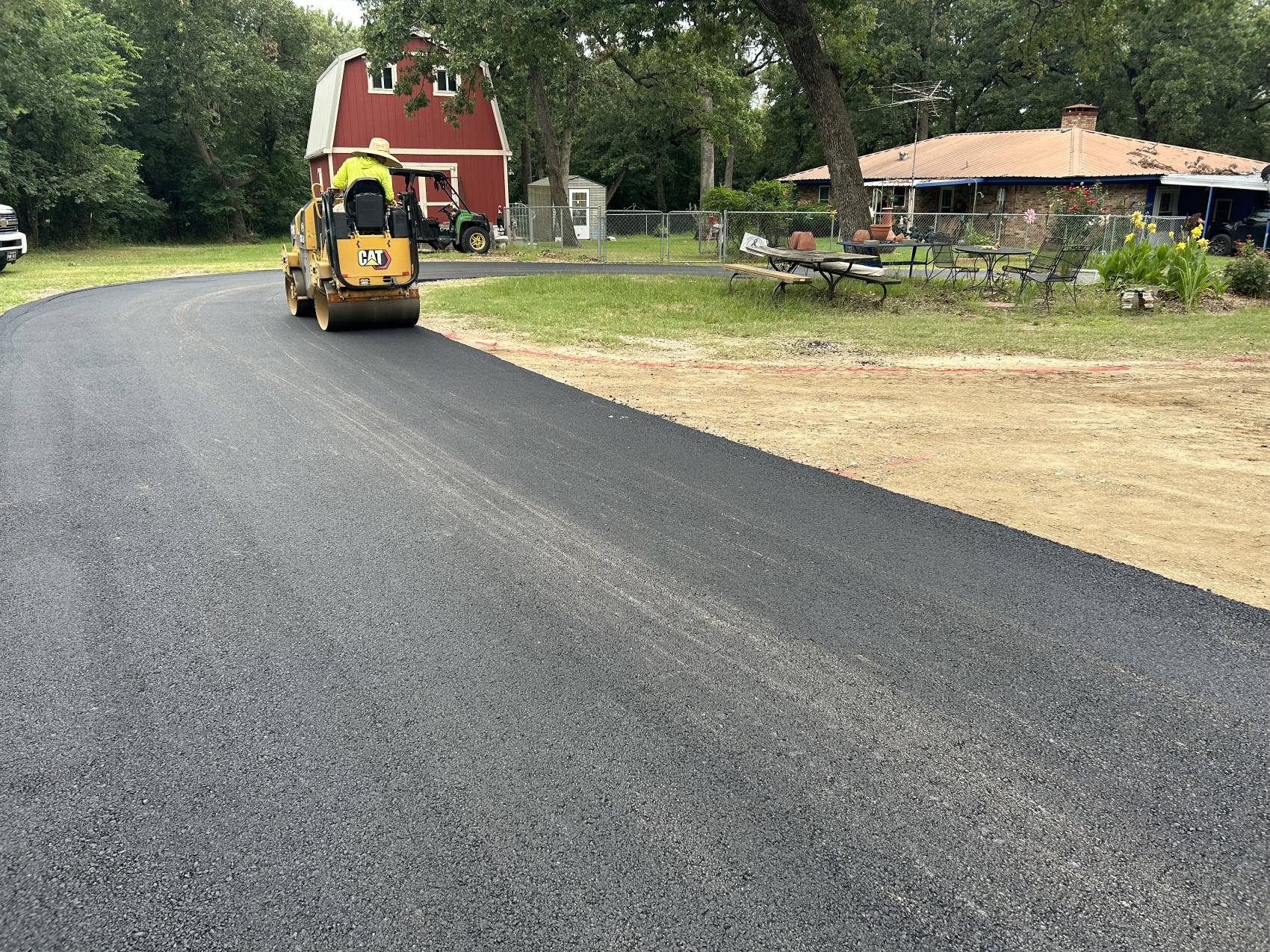
Driveway paving is the construction of a new asphalt surface running from your garage or house to the street, built to hold up under the daily weight of your vehicles while protecting your home from water damage at the same time. Unlike a parking lot or road, a driveway sits directly adjacent to your house, which makes grading and drainage even more important here than almost anywhere else on your property.
A properly built driveway is graded with a slight, consistent slope that carries rainwater away from your foundation and toward the yard or street instead of letting it collect near your house. Skip that detail, and water finds its way toward the foundation every time it rains, which can lead to moisture problems that have nothing to do with the asphalt itself and everything to do with how the site was graded before paving even started.
Driveway paving also has to account for the transition where the driveway meets your garage apron and where it meets the street. Those two points see the most turning stress and the most exposure to water runoff, and they’re often where a poorly built driveway starts to fail first.
What’s Included in Driveway Paving
- New driveway installation. Full-depth construction for driveways being paved for the first time.
- Driveway replacement. Removing an existing driveway that’s failed and rebuilding it correctly.
- Grading for drainage away from your home. Establishing the slope that protects your foundation from standing water.
- Garage apron and street transition finishing. Making sure both ends of your driveway tie in cleanly without abrupt edges.
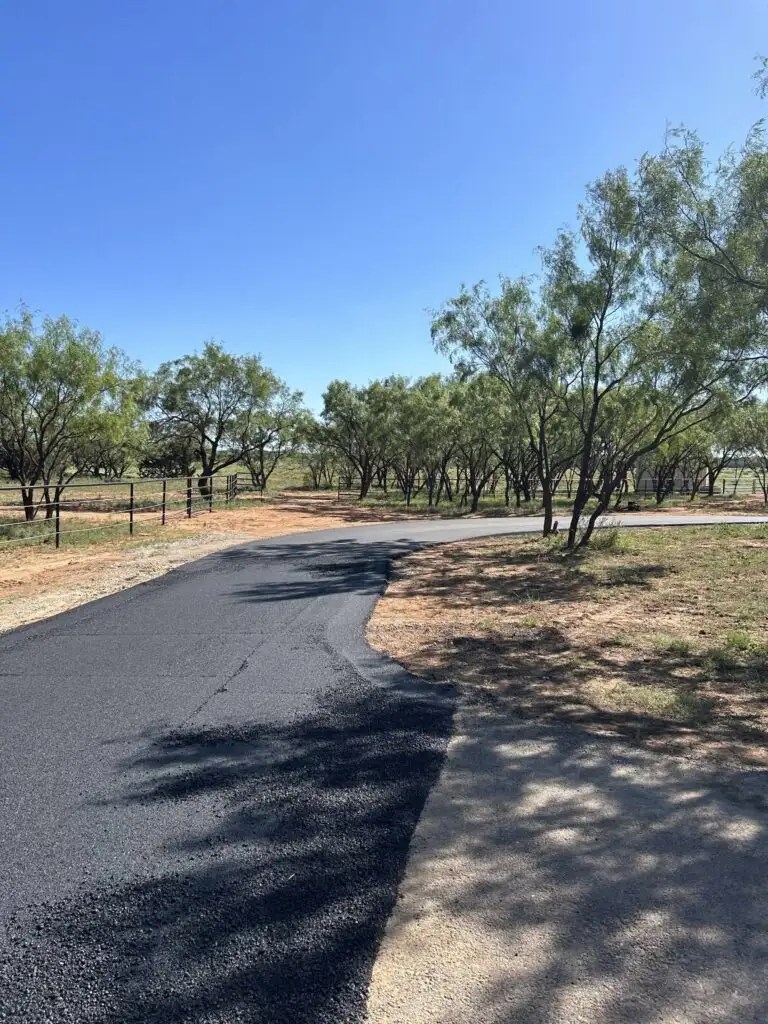
- Long or extended driveways. Larger residential properties with longer runs from the street to the house.
If your driveway needs sealcoating or crack filling rather than a new surface, that falls under our Asphalt Maintenance service.
Our Process
- Site walk and grading assessment. We look at how your property drains, where downspouts empty, and how the existing driveway or bare ground slopes relative to your house before we quote anything. Getting this wrong at the estimate stage means getting it wrong on the job site.
- Excavation. We remove the existing driveway, if there is one, along with any topsoil or organic material, down to a stable subgrade. This clears the way for a base that will actually support the finished surface instead of settling under it.
- Subgrade check and compaction. We compact the exposed soil and confirm it’s stable before anything else goes down. A driveway is only as strong as the ground underneath it, and this step is where most long-term problems either get prevented or get built in.
- Aggregate base placement. We place and compact a crushed stone base, sized to your specific subgrade conditions rather than a one-size-fits-all depth. This layer is what actually carries the weight of your vehicles down into the ground.
- Grading for slope away from the house. Before asphalt goes down, we establish a consistent grade that directs water away from your foundation. This is the single detail that protects your home the most, and it has to be right before we move to the next step.
- Asphalt placement and compaction. We place and compact the asphalt surface, working carefully around the garage apron and street transition so both ends tie in smoothly.
- Final grade and drainage check. We check the finished surface for proper slope and confirm water is moving away from the house before considering the job complete.
Warning Signs Your Driveway Needs Repaving
- Water pooling near your garage or foundation. This usually means the grade has failed or was never built correctly, and it’s worth addressing before it affects more than the driveway itself.
- Widespread cracking, especially near the edges. Cracking that spreads across the surface, rather than staying as a single hairline crack, often means the base underneath has started to break down.
- Potholes or soft spots. Areas that feel like they give underfoot mean water has already reached the base.
- Sinking or uneven sections. Parts of the driveway sitting noticeably lower than the rest usually point to base failure in that specific area.
- A driveway that’s visibly aged and worn. Fading, surface roughness, and general wear are signs it’s time to start planning for a replacement before a small problem becomes a big one.
Why Choose Gentry’s Paving Group
For most homeowners, a driveway is one of the few big-ticket projects on their property they’ll only do once every couple of decades, so it’s not something we treat as routine, even after 35+ years of doing it. James Gentry started this company in 1988 on driveways much like yours, and the company has grown almost entirely through homeowners telling their neighbors and family who did their driveway right, not through advertising.
Because your driveway sits directly against your foundation, we don’t treat grading as a formality on the way to the finished surface. It’s the detail that decides whether your driveway protects your home or slowly works against it, and we check it as carefully on a single-car driveway as we would on a quarter-mile drive out to a rural property. That’s the same standard whether it’s your first driveway project or your third.
Where We Offer Driveway Paving
We pave residential driveways throughout the neighborhoods and communities that make up our home service area: Rockwall, Forney, Terrell, Mesquite, Garland, Rowlett, Wylie, Sunnyvale, Kaufman, Royse City, and Greenville, along with anywhere else within 45 to 60 miles of Heath, Texas. If you’re a homeowner in one of these communities and you’re not sure whether your address falls in range, reach out and we’ll confirm before you commit to anything.
FAQ
How long does it take to pave a driveway?
Timeline depends on the size of the driveway, whether an existing surface needs to be removed first, and how much excavation and base work is required. We give a project-specific timeline after our site evaluation.
Does my driveway need to slope away from my house?
Yes. Proper grading directs rainwater away from your foundation instead of letting it pool near your house. This is one of the most important details we check before any asphalt goes down, since a driveway graded incorrectly can lead to moisture problems that go beyond the pavement itself.
Can you pave over my existing driveway, or do you have to remove it first?
It depends on the condition of the existing surface and base underneath. If the base has failed or there’s widespread cracking, we’ll need to remove the old driveway and rebuild it correctly. We’ll tell you honestly which situation applies during our site evaluation.
What affects the cost of a driveway paving project?
Cost factors include the size and length of the driveway, the condition of the existing subgrade, how much excavation and grading is needed, and whether an existing driveway needs to be removed. We provide a specific quote after evaluating your property.
Do you pave long driveways, or just standard residential ones?
We pave driveways of all lengths, including longer drives on larger residential properties.
Do you handle the transition where my driveway meets the garage and the street?
Yes. Finishing those transitions cleanly is part of every driveway paving job we do.
Ready to Get Your Driveway Paved Right?
Whether you’re planning a new driveway or need to talk through one that’s showing signs of water damage, Gentry’s Paving Group is ready to help. Call (972) 792-0000 or fill out our contact form to schedule a site evaluation.
Gentry’s Paving Group | 457 Laurence Drive, Suite 404, Heath, TX 75126 | (972) 792-0000